

Antisemitism: Prejudice That Does Not Sort
A New Boundless Study

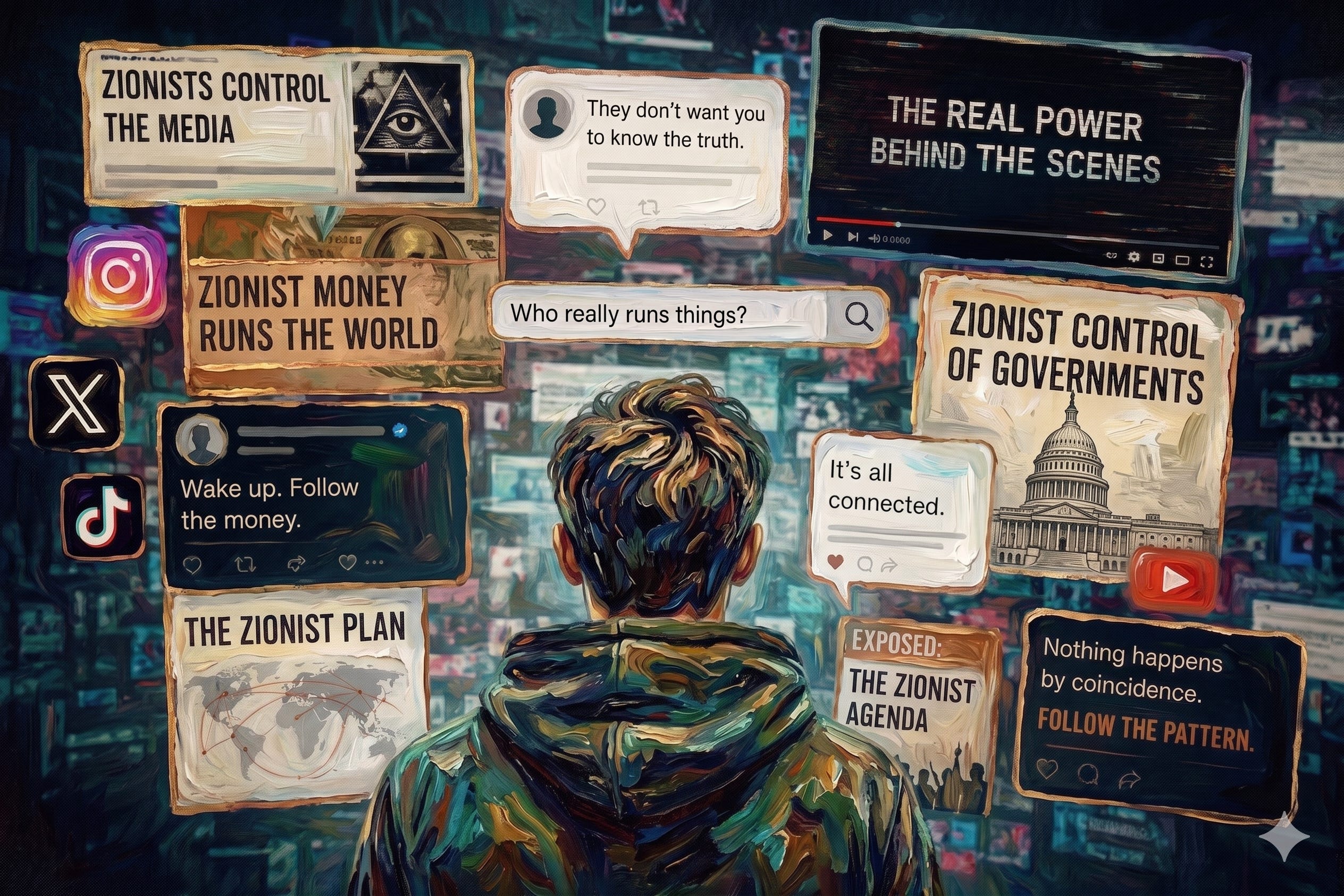
Arguments about antisemitism in America have settled into a familiar shape. One side locates the problem mostly on the right: the militias, the replacement theorists, the politicians who flirt with both, the pundits, influencers, and Youtubers. The other side locates it mostly on the left: the post-October 7 protest culture, the activist vocabularies of decolonization, the campus chants that have moved off campus. Each side has its evidence. Each side mostly believes the other is exaggerating, or inventing it for political advantage.
Boundless recently commissioned a major national study of media consumption and online antisemitism, in which 1,000 American adults were surveyed, nationally representative with oversample of young adults (aged 18-35). The results, published here, suggest that both stories are partly true. They also suggest that both stories miss what is actually happening, and that what is actually happening is worse than either: antisemitism is not simply migration from one political camp to another, but has become a prejudice that travels comfortably through both. In other words, Antisemitism does not sort the way other prejudices do.
Where other prejudices sort
The study turned up something strange. On almost every kind of prejudice it measured, conservative and liberal Americans live in different worlds. Ask whether discrimination against white people is as serious as discrimination against Black people, and conservative TV viewers say yes by a wide margin while liberal TV viewers say no. Ask whether all illegal immigrants should be deported, and the two camps split three to one. Ask whether women are better off at home with the kids. Same divide.
Now run it the other direction. Ask whether they’ve seen racist content online lately, and far more liberal viewers say yes than conservative viewers. Ask about anti-Muslim content, or anti-women content, and the gap is just as wide. On topic after topic, the partisan filter does exactly what it is supposed to do. It splits Americans into two countries that barely overlap, each one alert to the bigotry the other shrugs at.
Then we asked about Jews. The sorting stopped.
Three claims to keep separate
What we found takes three forms, and they’re worth keeping separate. The first is a claim about what people see online. The second is a claim about what they believe. The third is an interpretive conclusion the first two together force us toward. A caveat before any of them: self-reporting media exposure is imperfect, and reporting that you have seen anti-Jewish content online is not the same as endorsing it. But the strength of the finding does not rest on any single number. It rests on the fact that the same survey instrument that shows sharp partisan sorting on every other prejudice it measured shows almost none on Jews. The instrument is the constant, and the variable is the prejudice.
Start with exposure. Conservative and liberal TV viewers report encountering anti-Jewish content online at almost the same rate, around six in ten on either side; anti-Israel content, around seven in ten. That much could be the algorithms doing their work, pushing Jew-related material into every feed regardless of politics.
But exposure is not endorsement. When you ask people what they believe, the parity holds. Twenty-seven percent of conservative podcast listeners agree Jews use shady practices to get what they want; among liberal podcast listeners, 21%. On whether Jews have too much control and influence in the United States, conservative podcast listeners come in at 32%, liberal podcast listeners at 28%. Among television viewers the pattern actually inverts: 22% of conservative TV viewers agree Jews have too much control, against 31% of liberal TV viewers. The partisan filter that explains almost every other disagreement in American life does not explain how Americans feel about Jews.
This is the interpretive claim, and it matters because the way most of us have been arguing about antisemitism assumes the partisan filter works on this question the way it works on every other. It assumes a fight over which side has more, with each side accusing the other and defending its own. The Boundless data doesn’t settle that fight, but rather dissolves it. Antisemitism is the prejudice that does not sort. It moves through every silo and is the one hatred that crosses every line.
Why it travels
Why this should be true is not really a mystery. Antisemitism has always adapted to whatever ideological project is at hand. Put differently: whatever the antisemite needs the Jew to be is how the antisemite will portray the Jew. The right uses it as a story about subversion from above: Jews engineering the Great Replacement. The left uses it as a story about oppression from above, dressed up as decolonization: Jews as settler colonizers in Palestine. Both stories require different protagonists, but both end up finding the Jew.
Some of it is structural in a newer way. The strongest media predictor of anti-Jewish views in the Boundless data is not conservative or liberal television. It is non-traditional (and largely non-regulated) media: podcasts, YouTube, online newsletters, social media, news aggregators. People who get most of their information through these channels are markedly more likely to hold anti-Jewish views, regardless of their politics. Heavy social media users show elevated anti-Jewish views across the board, with agreement that Jews use shady practices jumping from 16% to 24%. Whatever the new media environment is doing to the American mind - be it algorithmic repetition, creating a conspiracy ecosystem, influencer incentives, distrust of institutions, or the fact that what “outrages engages” - it is doing something specific to how that mind thinks about Jews.
The wider survey
The rest of the survey fills in this picture in ways that should disturb anyone reading it. One in three Americans now holds at least one openly anti-Jewish view. One in six holds two or more. A third say they have seen content online claiming Zionists secretly control politics, media, or global finance. About a quarter of those who saw it consider the claim either true or a fair political opinion. Twenty-seven percent of Americans believe Israel directed the United States to recently attack Iran. These are not fringe positions but are mainstream enough that, applied to almost any other group, they would prompt emergency convenings.
The October 7 numbers are worse, and that is taking into account that not every harsh view of Israel is antisemitic. But conspiratorial claims about Zionist control, denial or minimization of Jewish victimization, and classic allegations of Jewish manipulation are. Two and a half years after the most heavily documented massacre of Jews since the Holocaust, with the attackers’ own footage in public circulation (what I’ve taken to calling the GoProGrom), only 49% of Americans believe Hamas committed acts of sexual violence that day. Among progressives, the figure is 39%; among Americans under thirty-five, the same. Forty-one percent of Americans believe Israel committed genocide in Gaza. Among progressives, that figure is 80%. Among younger Americans, 53%. Half the country is no longer sure whether to believe what was documented in real time.
The recognition gap
There is a thread that runs through all of this, and it is the one that makes the parity finding hurt the most. On every other category of bigotry, liberal viewers are far more likely than conservative viewers to recognize what they see as hate. They notice and name it. They take it seriously. Then you reach Jews, and the antiracist apparatus that runs so reliably elsewhere shuts down. The antiracist reflex suddenly becomes selective or uncertain or conditional. The recognition gap that exists for women, for Black people, for Muslims, for immigrants, just doesn’t exist for us. The machinery built to spot prejudice does not spot this one.
Politically homeless
We must recognize what this means for our community. Roughly one third of the surrounding population already holds at least one of the views that has historically preceded our worst centuries: claims of conspiracy, excessive Jewish power, manipulation, dual loyalty. The sorting mechanism that protects other minorities from sliding into majority hostility is not protecting us. There is no partisan vote that solves this. There is no media diet that fixes it. Whichever direction the country moves politically over the next decade, the data suggests Jews lose either way, because the prejudice doesn’t track the politics.
That is not the conclusion anyone wanted but it is what the numbers show. The comfort of believing antisemitism was a problem of one side or the other, and that one’s own side was the safer house, is no longer available. Both houses are leaking and the leak is in the foundation, not the roof. Until the leak is fixed, the Jews find themselves politically homeless.
What to do about it is a longer conversation. The first step is to stop having the wrong fight and start having the right fight: build cross-partisan monitoring, treat and expose antisemitism on traditional social media, teach robust media literacy, stop excusing in-group antisemitism, and teach others to distinguish legitimate criticism of Israel from conspiratorial antizionism. The fight over whose antisemitism is worse is the fight that produced this data. Whatever comes next has to start from the recognition that the old map of where the danger lives no longer matches the territory.
The danger lives everywhere.
Please post a link to the study?