

The City We Kept
You don’t have to endorse every Israeli government decision to understand why Jerusalem matters. And it matters a great deal.

Jerusalem. For a great many Jews, the word lands somewhere below the ribs before any thought arrives, a small catch in the breath, a pull eastward older than reason. It is a feeling carried, ritualized, and inherited across three thousand years. We are right to feel it, and we should be proud.
June 7 is the day to say so, because June 7 is the day the longing came home.
When the longing came home
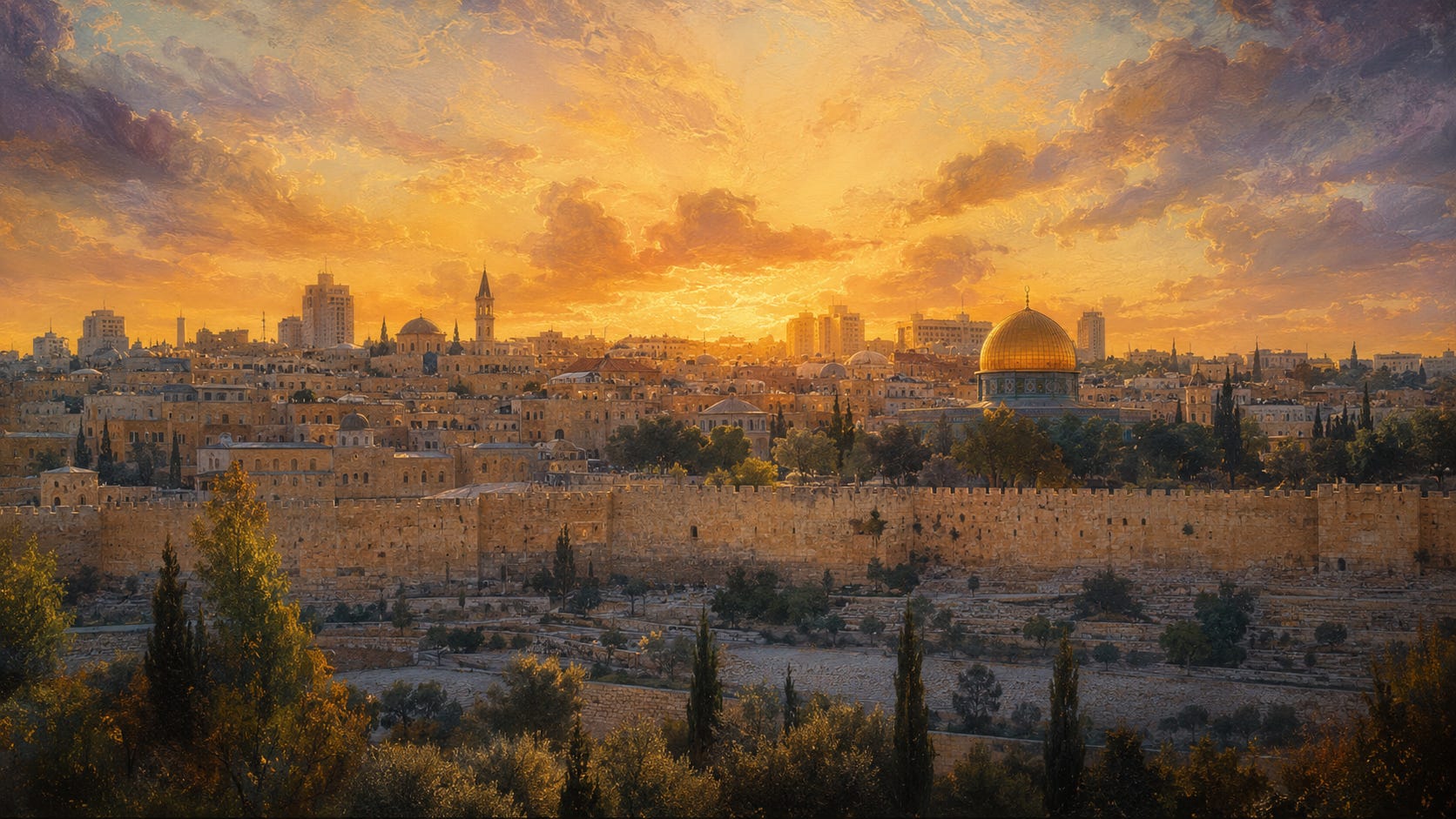
On June 7, 1967, Israeli paratroopers fought their way through the Old City and reached the Western Wall, the surviving wall of the Temple Mount, the closest a Jew could stand to the site of the Temple. Previously under Jordanian military control, no Jew had been allowed to stand there for almost 20 years. The IDF’s chief chaplain, Rabbi Goren, raised a shofar and sounded it against the stones. The brigade commander, Motta Gur, had already radioed the words that an entire generation of Israelis can still recite from memory: “Har habayit beyadeinu! The Temple Mount is in our hands!” Hardened men who had never thought of themselves as religious put their faces against the limestone and wept.
It was, of course, a military victory. But for the Jews who reached the Wall, it was not experienced only, or even mainly, as victory. It was homecoming. The weeping wasn’t the weeping of victors but the weeping of people who had arrived somewhere their grandparents had only been able to face from a distance and pray toward.
The Hebrew calendar marks the anniversary of the unification of Jerusalem as Yom Yerushalayim, which passed this spring. I am choosing to mark the secular date because for most of us in the Diaspora the memory attaches to June 1967 and the feats of the Six Day War.
A pride that was earned
The challenge is not to choose between pride and honesty. The challenge is to hold Jerusalem the way Jews have always held it: with longing, reverence, grief, and responsibility at once.
Here is what makes the pride legitimate: we didn’t stumble into a feeling about Jerusalem in 1948 and dress it up after the fact. We kept faith with this city for 2,000 years before we ever held it again.
For twenty centuries, Jews scattered across every continent prayed facing Jerusalem. Not toward a capital they were building but to a city they’d lost. The central prayer of Jewish liturgy, said three times a day, names Zion and Jerusalem five times and is recited while turned east (at least, in North America and Europe). The blessing after a meal asks for the city’s rebuilding. The Torah service proclaims that instruction goes forth from Zion. A Jew at prayer in Vilna or Marrakesh or Buenos Aires was, with his whole body, addressing one specific place on earth, and had been doing so since long before there was a political Zionist movement or a flag to raise over anything.
The longing was woven into the architecture of an entire life. At every Jewish wedding, at the height of joy, a glass is shattered under the canopy so that even our happiness carries the memory of a broken city. The exiles in Psalm 137 swore that if they forgot Jerusalem, their right hand should lose its skill, and Jews kept that vow operational for fifty generations because they understood that a people can be parted from a place and still refuse to let it go. On Tisha B’Av, Jews mourned the city’s destruction as though it were not ancient history but a wound in the present tense. Yehuda HaLevi, comfortable and celebrated in Spain, wrote that his heart was in the east while the rest of him stayed in the west, and then he stopped writing about it and set out for Jerusalem and is said to have died on the way.
This is the part worth standing tall over. It is hard to think of another people that has loved a city so liturgically, so bodily, and for so long in its absence. . We held it in memory when we could not hold it in fact, every single day, for two thousand years, with nothing to enforce the loyalty but the loyalty itself. And then, on a June morning in 1967, we held it again. Having and holding aren’t two separate things. They’re one act, interrupted for two millennia and rejoined at the Wall. The holding began long before sovereignty. Jews held Jerusalem in prayer, law, mourning, poetry, and direction. In 1967, that metaphysical holding became physical again. That is not an attachment anyone needs to double-think. It is one of the greatest acts of fidelity in human history.
Pride and honesty in the same hand
None of this requires pretending that holding Jerusalem is simple. The earthly city is real. It is crowded and contested, holy to others as well as to us. The same homecoming we are right to celebrate also remade the lives of the Palestinians who live there, and their lives, their claims, and their grievances are real. They cannot be wished away by Jewish memory, however ancient and legitimate that memory is. The city is governed, too, by fallible people who make hard decisions and sometimes the wrong ones, and a Jew can argue with any of those decisions, loudly, and should when conscience demands it. That is what it means to actually possess a thing rather than only to dream about it from afar. A people can hold a country in the moral imagination, but a real one needs garbage trucks and zoning fights and coalition compromises, the unglamorous business of actually existing. The dream answers to no one. A government answers to its citizens and to history both.
But the line holds, and that’s the point: a Jew does not have to endorse every decision of an Israeli government to understand why Jerusalem matters. Disagreeing with a coalition, for example, is not the same as conceding that your grandfather’s prayers were a fiction. You can criticize a minister with everything you have and still stand at that Wall with your whole chest, because the minister is a fact about this year and Jerusalem is a fact about three thousand of them. Jerusalem has outlasted kings, caliphs, crusaders, emperors, high commissioners, prime ministers, and more bad municipal planning than any holy city should have to endure. Memory is not policy and pride is not a blank check. The two have never needed each other’s permission.
So mark the day
Mark June 7, and mark it proudly. Not quietly, not with the cautious hedge that has crept into so much Jewish speech about Israel, as though every sentence of attachment now owes a sentence of apology or explanation. It doesn’t. Jerusalem matters a great deal, and we are the astonishing generation that gets to say “next year in Jerusalem” and mean a real city we can board a plane and reach by morning.
There is a story that in Jerusalem itself they add a word to the old phrase. Not next year in Jerusalem, but next year in the rebuilt Jerusalem, because there is always more to build, more to deserve, more to become worthy of. That is the correct posture for a proud people, and it is the opposite of complacency. You can be deeply, unembarrassedly proud of having and holding this city and still understand that holding it well is the work of every generation that gets the privilege.
We kept the city for 2,000 years, and the city kept us. On June 7 we reached it again. Be proud of that. Not apologetically, not defensively, not as a permission slip for every policy made in its name. Be proud. And then go be worthy of it.